Session shape
A queue, a commute, a wait — the unit of play is minutes, and structure follows.

The unit of play is a queue, a platform, the wait for a kettle.
Photo: Feyza Yıldırım / Pexels
The play fits the gap, not the other way around
A level in Candy Crush Saga takes roughly two minutes. That is not an accident of game design — it is an answer to a question about human behaviour: when do people have two minutes? At a bus stop. In a queue.
Waiting for a coffee. The session is shaped before the designer draws a single tile, because the context of play is already known. Mobile games do not ask for a player's full attention. They occupy the leftover time that other media cannot reach.
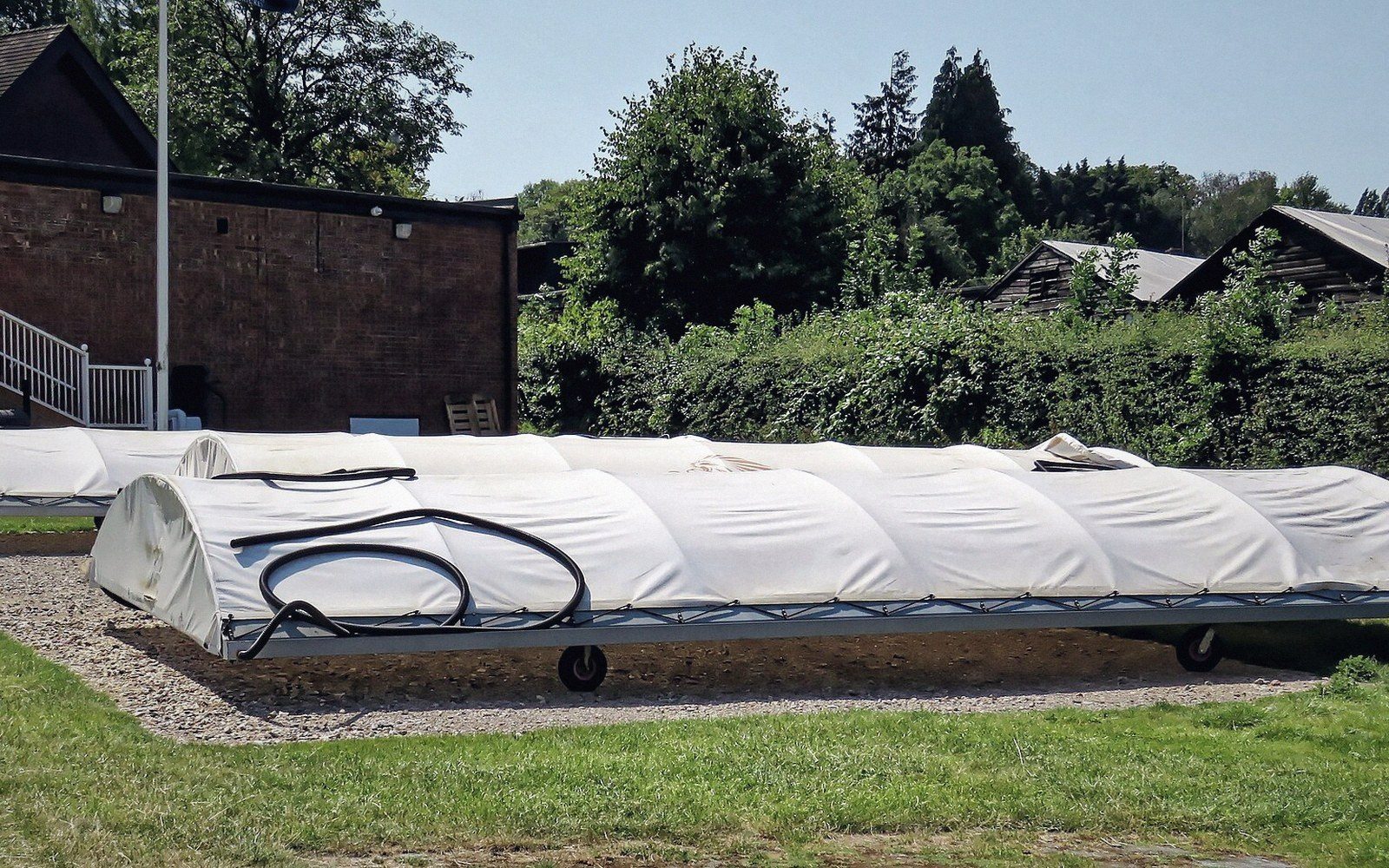
Cover on, cover off. Short-session design assumes the stop, then plans for it.
Photo: Radlett Cricket Club mobile pitch covers, Hertfordshire, England 2 · Wikimedia Commons
This inversion — fitting play to life rather than fitting life to play — is the central structural fact of mobile game design. Desktop and console games are built around a session the player chooses to begin.
Mobile sessions begin in the gap between other things, which means they can end at any moment too. The design has to hold together under that pressure: interruptible at any point, resumable without friction, rewarding in a timeframe that matches the gap being filled.
Short, legible, conclusive
The session unit in mobile is almost always a single level, a single match, or a short run. The reason is cognitive: a player who might be called away in ninety seconds needs to know where they are and what counts as done.
The structural logic
Lifted out of the flow
- Session = gap in the day, not a chosen sitting — design follows that constraint, not the other way around
- Single-level or single-match structure gives a clean exit point; incompleteness costs players
- Passive progress (build queues, timers) allows the game to run between sessions without requiring sustained attention
- Session length is a lever: too short = unsatisfied; too long = friction at the moment of natural exit
Levels with a clear win state — clear the board, reach a score, survive a wave — give the player a moment of completion that is satisfying whether or not another session follows immediately. Incompleteness has a cost. If the game cannot be abandoned cleanly, players learn not to start.
Supercell, based in Helsinki, built this principle deeply into Clash of Clans: a raid takes minutes, the build queue runs while the phone is in your pocket, and nothing requires sustained attention in a single sitting. The session is the raid; the game continues between sessions whether or not the player is present.

Session length is a structural decision, taken on paper before content exists.
Photo: picjumbo.com / Pexels
That separation of active play from passive progress is a formal decision with structural consequences — it lets the game fill any size of gap, from ninety seconds to twenty minutes, without asking the player to commit to either in advance.
Jesper Juul, in A Casual Revolution, framed this as a genuine design philosophy rather than a commercial compromise: the casual game player is not a lesser player but a player with different constraints. Those constraints — the commute, the waiting room, the three minutes between meetings — are as real and as worth designing for as the two-hour sitting a console player can offer.
The session as a designed unit
Session length is not just a consequence of game design — it is a lever. A session that ends too quickly leaves the player unsatisfied; one that runs too long misses the moment of natural exit and becomes friction.
Jesper Juul, A Casual Revolution — academic argument that casual players have distinct, legitimate constraints
The most durable mobile designs find the frequency that matches the rhythm of their players' days and then protect it. Ian Bogost's satirical Cow Clicker, built in 2010, made this visible by stripping everything else away: a timer, a click, a wait. The satire landed because the rhythm it exposed was already familiar.
King's Candy Crush Saga formalised the relationship between session length and the life meter mechanic. Lives are lost on failure and regenerate over time, which both caps the session and gives the player a reason to return at a specific interval.
Also worth having to hand
Lifted out of the flow
Key works and studios
- Supercell (Helsinki) — Clash of Clans formalises active/passive session split
- King — Candy Crush Saga ties session length directly to the lives mechanic
- Ian Bogost — Cow Clicker (2010) isolates and satirises the timer-rhythm loop
The session shape is partly designed and partly enforced — the game closes the door when the lives run out. Whether that is a pacing tool or a pressure mechanism depends on how it is implemented, and the design literature on dark patterns takes that question seriously.
What every approach shares is this: the session is a designed unit, not a by-product. Its length, its sense of beginning and end, its relationship to what comes before and after — all of it is deliberate.
The gap in the day exists whether or not a game fills it. The question a mobile designer answers is what shape of experience fits the gap well enough that a player reaches for the phone again the next time one opens up.